The Temperatures Rise for the Planet and Homelessness

Written by Alejandro Villafuerte

As an oppressive heat wave the likes of which has not been seen in 20 years rolls in through Spain, one cannot help but think reflect on our ever-heating planet. NASA’s Goddard Institute for Space Studies (GISS) has recorded a consistent rise in global temperatures since the 1980s, with every year racing neck-to-neck to be the one to hottest ever one record.

            Though we are all of us affected by this crisis, a population that is often overlooked in this conversation are those experiencing homelessness. This is for two reasons, one is that global climate change not only effects to day-to-day lives of these people, it also plays a role in the increase in the amount of people experiencing homelessness.

A homeless individual resting in the shade of a high rise’s terrace in Barcelona. Photo By Alejandro Villafuerte.

Heating climate’s impact on lives (and amount) of the homeless

To get a better sense of the problems that are faced by the chronically homeless, we can look at the work gathered by researchers Ramin and Svoboda, writing for the National Library of Medicine. Together they identified four primary obstacles that will be exacerbated. Those four include heat waves, air pollution, floods & storms, and infectious disease.

            In 2009, Ramin and Svoboda posited the following health impacts on homeless individuals:

·       Increased morbidity and mortality during heatwaves.

·       Increased morbidity and mortality secondary to underlying respiratory and cardiovascular conditions.

·       Increased mortality from floods and storms. Increased morbidity following floods and storms including: anxiety, PTSD, infectious diseases.

·       Increased incidence of West Nile virus including meningoencephalitis.

These hypotheses would prove to be true. The American Journal of Public Health identified that visits to the emergency room were increased during heat waves with more extreme temperatures, and that homeless individuals were more 1.29 times more likely to be admitted compared to their housed counterparts.

Storms are much stronger and the contrasts between the temperature of the day and night are very notable, which means that you have to dress warmer than normal, and when midday comes, you more clothes than you need: It’s exhausting.
— Ramon Feiner, Homeless Entrepreneur

Unexpectedly, there is also an emerging link between the heating planet and extreme winter weather events. The American Association for the Advancement of Science posited in their article Linking Artic variability and change with extreme winter weather in the United States that it is a fact that Arctic warming is twice the global average, which is leading to harsher weather events. In either case, these events are increasing, and events like last winter’s cold snap in Texas had casualties – especially those that had no refuge.

Cooling Down

As with any major social issue, there is no “silver bullet” solution to address each of these all at once. The following have been proposed as possible short and long-term solutions to different components:

·       Cooling centers: Local NGOs that are geared towards aiding homeless individuals often offer pop-up cooling centers wherein their beneficiaries can find temporary relief from the oppressive heat. If you would like to become involved, you can donate your time, talent, or treasure to supporting your local NGO in these efforts.

Support SOS Homeless!

·       Environment-forward organizations: Climate change is happening. Do your part! To learn more about how to do this, The Grantham Institute from Imperial College London has a great, easy-to-follow website here. You can also learn more about climate change through events like the UN’s yearly COP’s climate change conference. Pictured above is Homeless Entrepreneur’s Andrew Funk attending COP25 in Madrid, Spain.

·       Aid the homeless: homeless can be the result of a myriad of life’s circumstances, including systemic economic inequity. Multi-faceted problems require holistic solutions, which Homeless Entrepreneur offers.

Homeless Entrepreneur’s mission is to promote economic empowerment and poverty reduction via work and active citizenship, so people living in social exclusion can improve their quality of life. The quality of the lives of the homeless live is directly tied to those who are housed as well when it comes to climate change. Though homeless individuals bear the brunt of our heating world, what affects few today will affect many tomorrow. Click the link below to find out more about the work we do and how to get involved:

Learn more & Support Homeless Entrepreneur

Connect with the author, Alejandro Villafuerte, via LinkedIn!


Hostile Architecture and its Effects on the Homeless Population

Written by Taylor Hoying

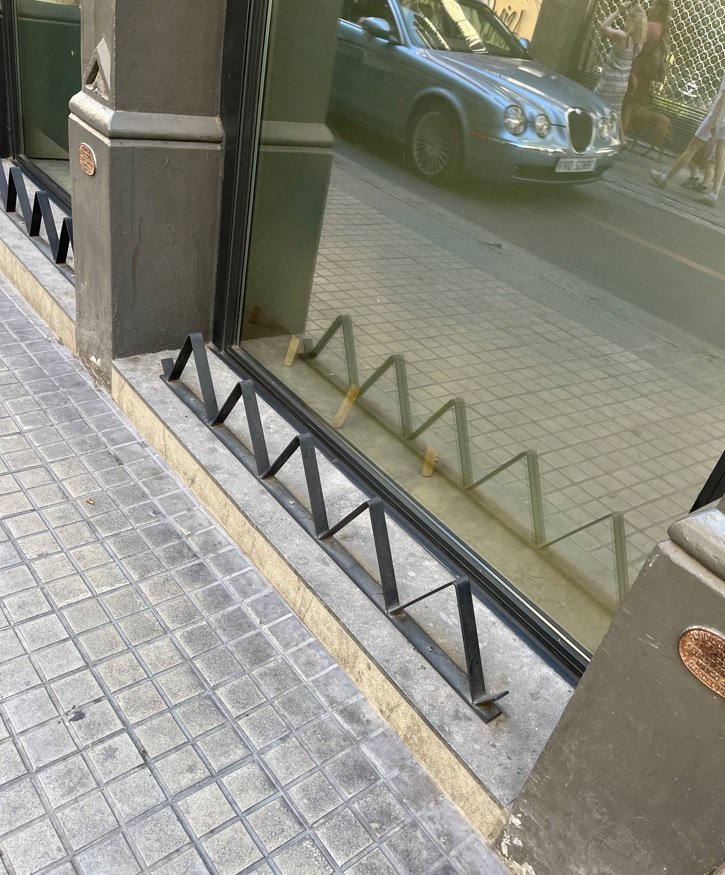
Public spaces are places that are generally believed to be accessible to everyone for a variety of purposes. Despite this, architecture and design have been used to discourage certain activities and exclude certain people since the 19th century. Awareness of hostile architecture has been on the rise recently, largely due a controversy in London in 2014, where metal spikes were installed to discourage homeless people from sleeping in flat areas. Concerned citizens have taken to social media to share photos of hostile architecture in their cities.

Picture taken by Juan González Iglesias in Madrid.

It keeps the uncomfortable truth away from general viewing and makes for plausible deniability so they can play down the severity of the homeless situation.
— @AndrewCraig via Twitter

Although these small aspects of our cities may not make a large impression on the everyday person, they have a large impact on the homeless community. Imagine coming home at night and finding that someone has replaced your bed with metal spikes. While perhaps unfathomable to most people, this is the unfortunate reality for many people who are homeless. I spoke with Homeless Entrepreneur Ramón Feiner about his experience with hostile architecture.

This kind of architecture is a big problem, because it is a way that society shows that they don’t accept or want you, and it makes you feel sad and alone. Nowadays it is very difficult to find a place to sleep after a hard day.
— Ramón Feiner, Homeless Entrepreneur

Hostile architecture is defined as “architecture used to guide or restrict behavior in urban space as a form of crime prevention or protection of property” (Chellew, 2019). While this alone may not sound like a bad thing, this type of design disproportionately affects the people who rely on public spaces the most, such as people who are homeless. Unfortunately, not every example of hostile architecture is overtly negative and obvious to the public.

Picture taken by Taylor Hoying in Barcelona.

When walking past a bench with arm rests throughout the center, your first thought is likely not how it is now impossible for someone to lay down. Similarly, when looking underneath a highway overpass, seeing rocks or concrete slabs likely does not cause you to think about those who can no longer access a dry place in the rain. These subtle installations largely fly under the radar, unless someone calls attention to them.

In Barcelona, the chairs and benches made specifically against people sleeping on it…… Seen it in NY and London too…. That’s not how you fight homelessness.
— Agnès Batllori Benet, Internal communication specialist

Picture taken by Taylor Hoying in Barcelona.

Conversely, some examples of hostile architecture are so obvious as to leave no doubt about their true purpose. Metal spikes tend to attract attention, as do metal bars intended to block access to dry areas. Although these explicit examples do receive more backlash, they remain in cities, and continue to make life harder for people already experiencing more difficulty than many of us can imagine. During a conversation about hostile architecture, artist Juan González Iglesias described the installations in his area.

Around my hood, there are some KILLER STRUCTURES. It feels just evil, soulless. Vertical spikes, with no other purpose. Black and horrible, they look clearly nasty.
— Juan González Iglesias, Artist

To see firsthand how many installations I could find in my own city, I took a walk around Barcelona. Within 10 minutes, I found 4 windowsills that were full of metal bars. To see if there was a way to still make the space usable, I attempted to relax there for a moment. I found that it was exceedingly uncomfortable to even stand on the ledge, let alone lay or sit down.

Send Us Images & Videos of Hostile Architecture!

Hostile architecture does not only take the form of additions to public spaces; it can also manifest in the form of removal. By removing the backs of public seating or benches, design encourages people not to linger, and by extension, removes yet another place for the homeless to sleep. By simply not including bathrooms or benches in public spaces, the space becomes accessible only to those who have somewhere else to go.

Donate & Support Social Policy Improvements

It is easy for a person to ignore problems that do not personally affect them, but the installation of hostile architecture is something that everyone should be concerned about, because everyone is affected. This concept is easily demonstrated by taking a walk down Las Ramblas in Barcelona. From La Boqueria all the way down to the beach, there is not a single bench or unadorned windowsill. Excluding the restaurants, there is not a single place to sit and enjoy the city. The removal of public seating might encourage the homeless not to linger in a popular tourist area, but it also causes the patrons of the shops to pass through quickly.

It affects people who are not homeless since everybody has the need at some point to sit and relex.
— Ramon Senserrich, Homeless Entrepreneur coach

Homeless Entrepreneur works to end homelessness through economic empowerment and provide support for those who want to improve their lives, but do not have the resources to do so. Through initiatives such as The Launchpad Housing Program and the HELP Program, Homeless Entrepreneur helps create opportunities for housing and economic growth. While these processes have the goal of getting homeless people off the streets and into stable housing, it is important to also consider their quality of life while they are still sleeping rough. Hostile architecture is appropriately nicknamed anti-homeless architecture. By cutting down the already limited options available to homeless people, we further isolate those that we should be attempting to bring closer.

Donate & End Homelessness with us!

Connect with the author, Taylor Hoying, via LinkedIn!


The Effects of Homeless Shelters Overprotecting Residents

Written by Avery Berlin

A recent study published in Catalan News found that in the last 13 years, the number of people sleeping on the streets has increased by 62%. Figures that estimate homeless people do not only include those who are sleeping on the streets, but also include people staying in public and private shelters, hostels, temporary housing, and more. The Homeless Care Network (XAPSLL) estimates that almost 3,000 people sleep in public and private shelters, while almost 900 find shelter in informal housing (Nearly half of the homeless people in Barcelona have lived on streets for over two years, 2022).

Get more insight on homelessness

Homeless shelters around the world have provided a safe haven for people living on the streets. In addition to shelter, these facilities often provide food, clothing, amongst other resources. These needs are essential for survival, however, homeless shelters can overprotect residents and prevent them from reaching their fullest potential. “2015 Diagnosis,” a document detailing the situation of homelessness in Barcelona describes homeless shelters as “a first step.” They explain how homeless shelters can create a “revolving door effect,” meaning that homeless populations are often not receiving the attention they need at a specific facility, so they might move to another facility, beginning the entire cycle again of finding a shelter and receiving services (Marco et. al, 2015).

Salvation Army of St. Petersburg Emergency Shelter in St. Petersburg, FL

In addition to this “revolving door effect,” there are many drawbacks of homeless shelters. In a discussion with Nikki, founder of Lux and Black, a London-based clothing line of ethically sourced clothing, she explained the advantages and disadvantages of homeless shelters. 

The system to help [the homeless population] is not reflective of their needs, nor does it help the homeless efficiently or effectively enough to go back into the world of work and be more productive members of society.
— Nikki, founder of Lux and Black

She also mentioned that despite the shelters providing basic necessities, many problems still remain. Men and women are often in separate areas while sleeping, yet this might also separate couples and families. Despite drugs and alcohol being banned from the facilities, people still find ways to sneak them in, which can create an unsafe environment for other residents. On the same note of an unsafe environment, theft of possessions often takes place while residents are sleeping, further creating problems for residents who already have so few possessions that cannot easily be replaced.

The intricacies and luxuries we take for granted like being able to go online, have a laptop, and help of our friends and family, they don’t have, so it’s incredibly hard to get out of this cycle. They need so much in order to be able to apply for and be successful in a job application, but there isn’t easy access to this at all. This part of the process is very flawed and pretty much only allows them to work cash in hand jobs, which isn’t sustainable. They need an address to be able to put on their job applications so they can apply for more permanent work.
— Nikki, founder of Lux and Black

Clinton Amam, writer and Homeless Entrepreneur in Nigeria

Despite all of the above problems, Writer and Homeless Entrepreneur Clinton Amam defined a list of the positives of homeless shelters. First, shelters can provide a place for like minded creatives and skilled people to meet each other. In addition, he described how this community can be a newfound family to make you feel at home that can also reduce depression as the homeless now have people to talk to, play, and interact with. However, despite these advantages, he explained how homeless people in shelters were prone to bullying, fighting, possible disease outbreaks, and harsh rules that might not be in your favor. In Clinton’s opinion, homeless shelters do not provide the support or help with plans for their residents to leave their current state or place.

With determination, skills, space, and support, there is a possibility or even high chance that they can get back on their feet as active and working citizens.
— Clinton Amam, Writer and Homeless Entrepreneur
Learn more about Clinton's HELP Program

Homeless Entrepreneur’s mission is to promote economic empowerment and poverty reduction via work and active citizenship. Homeless shelters, on the other hand, provide a sense of temporality and lack the resources that the homeless population needs to be able to break the cycle in order to become motivated, active, and participative citizens. Homeless Entrepreneur offers extensive resources to assist homeless people in getting out of their situations and transforming them into active members of society. In specific, the Launchpad Housing Program “is designed to turn a liability in the housing sector into an asset for addressing homelessness.”

Donate & Support

The Launchpad Housing Program creates opportunities for local organizations such as governing bodies, NGOs, and hotels to create social impact by identifying homeless people and relevant opportunities for both parties. During the pandemic, Homeless Entrepreneur created the #HomelessHostelsWork program, encouraging local accommodations and businesses to turn their liability into an asset for the homeless population, allowing both the businesses and homeless people to benefit from the partnership. The Launchpad Housing Program also encourages local NGOs and governing bodies to be more creative and leverage their current resources to develop social impact and opportunities for the homeless population.


Despite the ability for homeless shelters to provide resources to people in need, these shelters must be temporary solutions to help the long term goal of ending homelessness. Homeless shelters often do not identify talent or the goals of individuals, creating a constant cycle of temporary resources that do not contribute to the end goal. Homeless Entrepreneur has developed resources to push these individuals to reach their fullest potential, which likely cannot occur solely with the help of homeless shelters.

Donate & Support our Launchpad Housing Program

Connect with the author, Avery Berlin, via LinkedIn!