Exploding Public Debt & Budget Surplus Boom

Written by Louise Maheo

WHAT ARE WE TALKING ABOUT?
Humans are social beings and have learned to live in societies for thousands of years. A group is a numerical advantage in times when predators much bigger than a human beings were a danger to the human species. Over the years, humans have been able to rise to the top of the food chain and build a powerful society. At the national level, a society is not autonomous, insofar as it depends on countries for its trade and its politics. Humans have made their society an autonomous, global construction, even though, on a planetary scale, we consume more resources than the earth can produce.
WHAT IS PUBLIC DEBT?

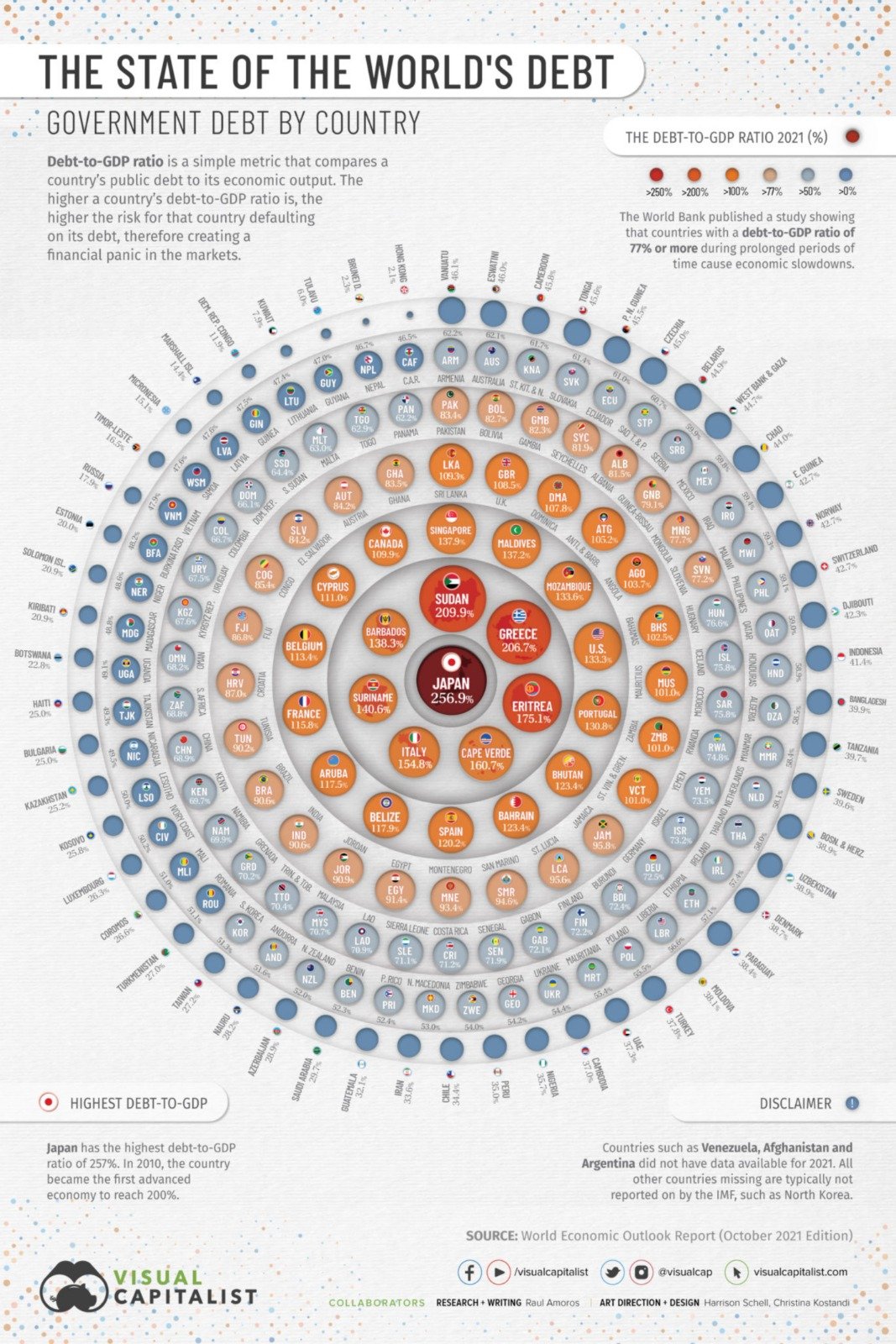
Public debt works in the same way people extract resources without contributing and become dependent on an expensive and unproductive system. It is an accumulation of current expenditure not covered by covered by revenues. Public debt is usually explained as a percentage of gross domestic product (GDP). Using this name allows the debt to be compared to the size of each country's economy, and it also facilitates international comparisons between countries.

Public debt tends to be a chronic item in state budgets. Today, with the current governments that avoid austerity, far from amortizing it, they get more indebted.
In the end, if it is paid for, it will be by future generations for the most part.
— Juan Matilla, Financial Coach at Homeless Entrepreneur
End Homelessness with us

DO WE REALLY KNOW WHEN PUBLIC DEBT STARTED?

We asked William Thomson, the founder of Virtual Event Campus, who is studying in a MSc in the Green Economy.

It’s existed for 100s of years in almost every country. Up until 1971 debt was linked to a countries ability to change notes/coins to gold (gold standard) but this constrained US spending on Vietnam so they ended the exchange. Now currency is fiat meaning its a promise to pay.
— Willam Thomson, Co-host of SCOTONOMICS
Learn more about our Social Policy Department

With this testimony, we can see that over the years, debt has not developed in the same way, it is not the same as before. Money has also changed its status, since everything is virtual and our bank accounts are just numbers.

So government debt has always been with us. Most countries most years run deficits (gaps between tax and spending) and having a “debt” is normal. So there’s unlikely to be any set date for the start of debt. Also, government debt isn’t like household debt and a government debt is partly public surplus.
— Willam Thomson, Co-host of SCOTONOMICS

WHAT FACTORS ENCOURAGE PUBLIC DEBT?

Public debt leads to high inflation hence people experiencing poverty only suffer because the cost of living increases.
— Clinton Amam, Statistician & Homeless Entrepreneur in Nigeria
Donate & Support Clinton's HELP Program

CAN THE PUBLIC DEBT BE REPAID?

I believe public debt CAN be repaid, otherwise lenders wouldn’t lend money. Now, if you ask me if public debt SHOULD be completely repaid, I’d say NO because it isn’t necessary. I believe this because it can be used as a tool for creating more profitable money, which allows the debt to be increased intelligently.
— Daniel Amatriain, recent marketing graduate from ESIC, who is entering the venture capital world as an employee in Sept 2022.

BUDGET SURPLUS

The opposite of this situation would be a budget surplus boom, as people generate wealth and consume resources while contributing and becoming active, independent citizens. This situation could be compared to the highest point of efficiency in both demand and supply: everything is optimized.

Community Surplus

HOW CAN THE BUDGET SURPLUS BE OPTIMIZED?

Theoretically, buyers buy at the highest price, and sellers at the lowest price. Thus, buyers and sellers optimize their activities. The budget surplus is obtained by adding the consumer surplus and the producer surplus. These are the surpluses that form the laws of the market. The surplus is a measure of the gains from the exchange, i.e. the advantage drawn by the participants (producers or consumers). Therefore, the higher the surplus, the higher the gains from exchange.

To conclude, although it seemed legitimate and normal to ask those who benefited from these current expenses to finance them through a "refundable credit," it was not successful. Since COVID-19 crisis, most countries have seen their public debt increase, being obliged to borrow from the financial market to repay their debt. The “perfect” solution would be to encourage companies to participate in the budget surplus boom because it would encourage markets and the result would be increased state flexibility, reduced interest costs and the ability to invest in future growth.

Send us your feedback or contribution!

*Thank you for reading this article! If you would like to contribute your thoughts, pictures or videos to this article or believe you have found mistakes and/or misinformation, please contact us and tell us about it by clicking on the button next to this text, so we can take your feedback into consideration.

Connect with the author, Louise Maheo, via LinkedIn!


The Temperatures Rise for the Planet and Homelessness

Written by Alejandro Villafuerte

As an oppressive heat wave the likes of which has not been seen in 20 years rolls in through Spain, one cannot help but think reflect on our ever-heating planet. NASA’s Goddard Institute for Space Studies (GISS) has recorded a consistent rise in global temperatures since the 1980s, with every year racing neck-to-neck to be the one to hottest ever one record.

            Though we are all of us affected by this crisis, a population that is often overlooked in this conversation are those experiencing homelessness. This is for two reasons, one is that global climate change not only effects to day-to-day lives of these people, it also plays a role in the increase in the amount of people experiencing homelessness.

A homeless individual resting in the shade of a high rise’s terrace in Barcelona. Photo By Alejandro Villafuerte.

Heating climate’s impact on lives (and amount) of the homeless

To get a better sense of the problems that are faced by the chronically homeless, we can look at the work gathered by researchers Ramin and Svoboda, writing for the National Library of Medicine. Together they identified four primary obstacles that will be exacerbated. Those four include heat waves, air pollution, floods & storms, and infectious disease.

            In 2009, Ramin and Svoboda posited the following health impacts on homeless individuals:

·       Increased morbidity and mortality during heatwaves.

·       Increased morbidity and mortality secondary to underlying respiratory and cardiovascular conditions.

·       Increased mortality from floods and storms. Increased morbidity following floods and storms including: anxiety, PTSD, infectious diseases.

·       Increased incidence of West Nile virus including meningoencephalitis.

These hypotheses would prove to be true. The American Journal of Public Health identified that visits to the emergency room were increased during heat waves with more extreme temperatures, and that homeless individuals were more 1.29 times more likely to be admitted compared to their housed counterparts.

Storms are much stronger and the contrasts between the temperature of the day and night are very notable, which means that you have to dress warmer than normal, and when midday comes, you more clothes than you need: It’s exhausting.
— Ramon Feiner, Homeless Entrepreneur

Unexpectedly, there is also an emerging link between the heating planet and extreme winter weather events. The American Association for the Advancement of Science posited in their article Linking Artic variability and change with extreme winter weather in the United States that it is a fact that Arctic warming is twice the global average, which is leading to harsher weather events. In either case, these events are increasing, and events like last winter’s cold snap in Texas had casualties – especially those that had no refuge.

Cooling Down

As with any major social issue, there is no “silver bullet” solution to address each of these all at once. The following have been proposed as possible short and long-term solutions to different components:

·       Cooling centers: Local NGOs that are geared towards aiding homeless individuals often offer pop-up cooling centers wherein their beneficiaries can find temporary relief from the oppressive heat. If you would like to become involved, you can donate your time, talent, or treasure to supporting your local NGO in these efforts.

Support SOS Homeless!

·       Environment-forward organizations: Climate change is happening. Do your part! To learn more about how to do this, The Grantham Institute from Imperial College London has a great, easy-to-follow website here. You can also learn more about climate change through events like the UN’s yearly COP’s climate change conference. Pictured above is Homeless Entrepreneur’s Andrew Funk attending COP25 in Madrid, Spain.

·       Aid the homeless: homeless can be the result of a myriad of life’s circumstances, including systemic economic inequity. Multi-faceted problems require holistic solutions, which Homeless Entrepreneur offers.

Homeless Entrepreneur’s mission is to promote economic empowerment and poverty reduction via work and active citizenship, so people living in social exclusion can improve their quality of life. The quality of the lives of the homeless live is directly tied to those who are housed as well when it comes to climate change. Though homeless individuals bear the brunt of our heating world, what affects few today will affect many tomorrow. Click the link below to find out more about the work we do and how to get involved:

Learn more & Support Homeless Entrepreneur

Connect with the author, Alejandro Villafuerte, via LinkedIn!


Hostile Architecture and its Effects on the Homeless Population

Written by Taylor Hoying

Public spaces are places that are generally believed to be accessible to everyone for a variety of purposes. Despite this, architecture and design have been used to discourage certain activities and exclude certain people since the 19th century. Awareness of hostile architecture has been on the rise recently, largely due a controversy in London in 2014, where metal spikes were installed to discourage homeless people from sleeping in flat areas. Concerned citizens have taken to social media to share photos of hostile architecture in their cities.

Picture taken by Juan González Iglesias in Madrid.

It keeps the uncomfortable truth away from general viewing and makes for plausible deniability so they can play down the severity of the homeless situation.
— @AndrewCraig via Twitter

Although these small aspects of our cities may not make a large impression on the everyday person, they have a large impact on the homeless community. Imagine coming home at night and finding that someone has replaced your bed with metal spikes. While perhaps unfathomable to most people, this is the unfortunate reality for many people who are homeless. I spoke with Homeless Entrepreneur Ramón Feiner about his experience with hostile architecture.

This kind of architecture is a big problem, because it is a way that society shows that they don’t accept or want you, and it makes you feel sad and alone. Nowadays it is very difficult to find a place to sleep after a hard day.
— Ramón Feiner, Homeless Entrepreneur

Hostile architecture is defined as “architecture used to guide or restrict behavior in urban space as a form of crime prevention or protection of property” (Chellew, 2019). While this alone may not sound like a bad thing, this type of design disproportionately affects the people who rely on public spaces the most, such as people who are homeless. Unfortunately, not every example of hostile architecture is overtly negative and obvious to the public.

Picture taken by Taylor Hoying in Barcelona.

When walking past a bench with arm rests throughout the center, your first thought is likely not how it is now impossible for someone to lay down. Similarly, when looking underneath a highway overpass, seeing rocks or concrete slabs likely does not cause you to think about those who can no longer access a dry place in the rain. These subtle installations largely fly under the radar, unless someone calls attention to them.

In Barcelona, the chairs and benches made specifically against people sleeping on it…… Seen it in NY and London too…. That’s not how you fight homelessness.
— Agnès Batllori Benet, Internal communication specialist

Picture taken by Taylor Hoying in Barcelona.

Conversely, some examples of hostile architecture are so obvious as to leave no doubt about their true purpose. Metal spikes tend to attract attention, as do metal bars intended to block access to dry areas. Although these explicit examples do receive more backlash, they remain in cities, and continue to make life harder for people already experiencing more difficulty than many of us can imagine. During a conversation about hostile architecture, artist Juan González Iglesias described the installations in his area.

Around my hood, there are some KILLER STRUCTURES. It feels just evil, soulless. Vertical spikes, with no other purpose. Black and horrible, they look clearly nasty.
— Juan González Iglesias, Artist

To see firsthand how many installations I could find in my own city, I took a walk around Barcelona. Within 10 minutes, I found 4 windowsills that were full of metal bars. To see if there was a way to still make the space usable, I attempted to relax there for a moment. I found that it was exceedingly uncomfortable to even stand on the ledge, let alone lay or sit down.

Send Us Images & Videos of Hostile Architecture!

Hostile architecture does not only take the form of additions to public spaces; it can also manifest in the form of removal. By removing the backs of public seating or benches, design encourages people not to linger, and by extension, removes yet another place for the homeless to sleep. By simply not including bathrooms or benches in public spaces, the space becomes accessible only to those who have somewhere else to go.

Donate & Support Social Policy Improvements

It is easy for a person to ignore problems that do not personally affect them, but the installation of hostile architecture is something that everyone should be concerned about, because everyone is affected. This concept is easily demonstrated by taking a walk down Las Ramblas in Barcelona. From La Boqueria all the way down to the beach, there is not a single bench or unadorned windowsill. Excluding the restaurants, there is not a single place to sit and enjoy the city. The removal of public seating might encourage the homeless not to linger in a popular tourist area, but it also causes the patrons of the shops to pass through quickly.

It affects people who are not homeless since everybody has the need at some point to sit and relex.
— Ramon Senserrich, Homeless Entrepreneur coach

Homeless Entrepreneur works to end homelessness through economic empowerment and provide support for those who want to improve their lives, but do not have the resources to do so. Through initiatives such as The Launchpad Housing Program and the HELP Program, Homeless Entrepreneur helps create opportunities for housing and economic growth. While these processes have the goal of getting homeless people off the streets and into stable housing, it is important to also consider their quality of life while they are still sleeping rough. Hostile architecture is appropriately nicknamed anti-homeless architecture. By cutting down the already limited options available to homeless people, we further isolate those that we should be attempting to bring closer.

Donate & End Homelessness with us!

Connect with the author, Taylor Hoying, via LinkedIn!